El Nino Redefined: 'RONI' Replaces 'ONI'

Key Takeaways:
- NOAA has updated the El Nino–La Nina classification system after 75 years to account for warming oceans.
- The Relative Oceanic Nino Index (RONI) will replace the traditional ONI for defining ENSO phases.
- La Nina conditions remain present, with a transition to ENSO-neutral likely during Feb–Apr 2026.
- ENSO-neutral conditions could become more frequent, while El Nino events may weaken in strength.
In early 2026, the US National Oceanic and Atmospheric Administration (NOAA) updated its criteria for classifying El Nino and La Nina events. It is the first major change in 75 years – primarily to offset rapidly growing long-term global warming trends. NOAA and other agencies are transitioning from the traditional Oceanic Nino Index (ONI) to a ‘Relative Oceanic Nino Index’ (RONI) to define El Nino, beginning in early 2026. Over a period of time, it was felt that human-induced climate change has overpowered and hence altered the basic characteristics of the ocean temperature profile, which is the decisive factor for assessing, monitoring and predicting El Nino.
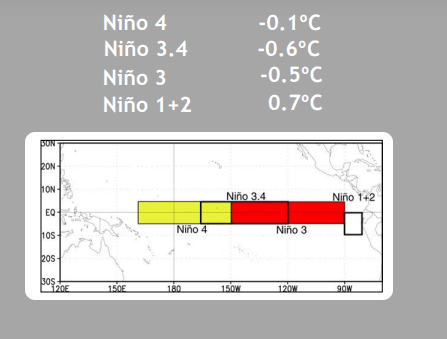
NOAA is renewing El Nino/La Nina criteria by introducing a “relative” index, rather than a fixed historical average, to better reflect ocean-atmosphere coupling in a warmer world. This change caters for rising global temperatures and its impact on long-term climate change on baseline sea surface temperature. The traditional criterion was based on the ONI, defined as the three-month average sea surface temperature (SST) anomaly in the Nino 3.4 region exceeding +/- 0.5°C for five consecutive overlapping quarters. As a result of global warming and climate change, the traditional fixed baseline of a 30-year period (1990-2020 now) makes it harder to distinguish between El Nino and generally warm ocean. The threshold for defining El Nino became too easy to hit, while La Nina became harder to achieve, even when the atmospheric conditions advised so.
Now, in the RONI approach, the temperature of the Nino 3.4 region is measured relative to the rest of the tropical oceans (20°S-20°N). As per NOAA, this will provide a more accurate “relative” measure of the actual ocean-atmosphere coupling, focusing on the localized anomaly that drives global weather, rather than the absolute temperature affected by climate.
ENSO: Redefining the Ocean Nino Index will retain the fundamental threshold of +/-0.5°C for El Nino or La Nina, but it will now be applied to relative deviations. With the new criterion, some of the past events will also get classified differently. The ‘strong’ El Nino of the past may fall into a slightly weaker category of ‘moderate’. Also, the longevity of ENSO-neutral conditions is expected to increase.
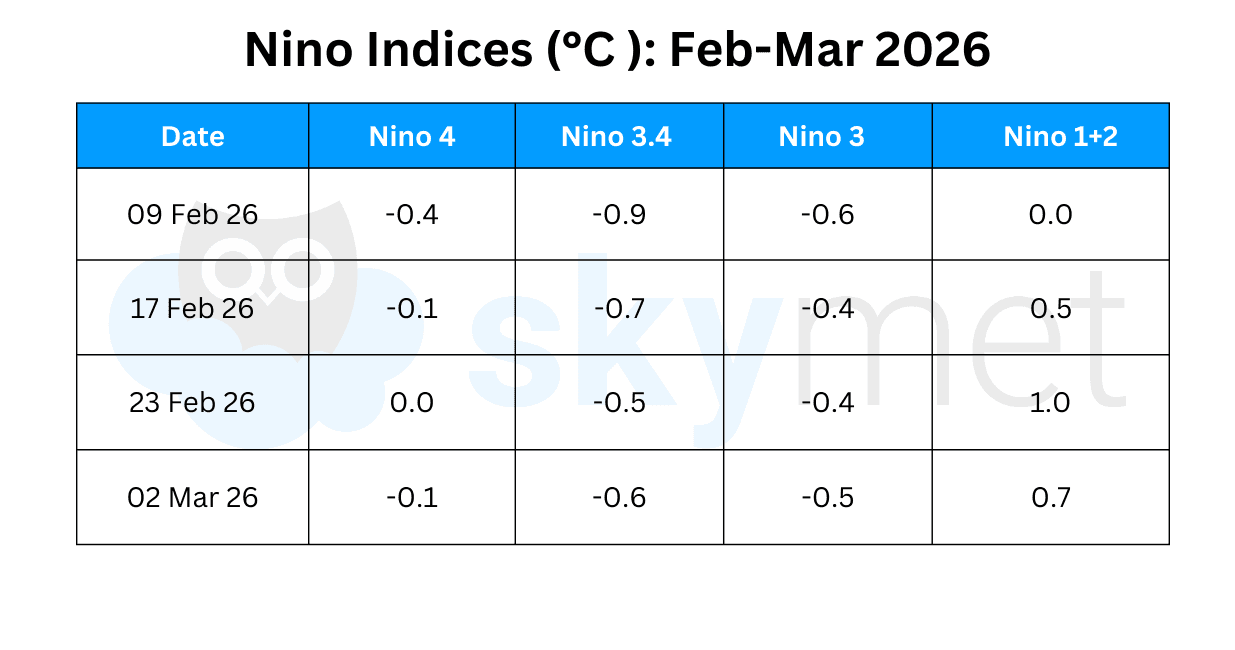
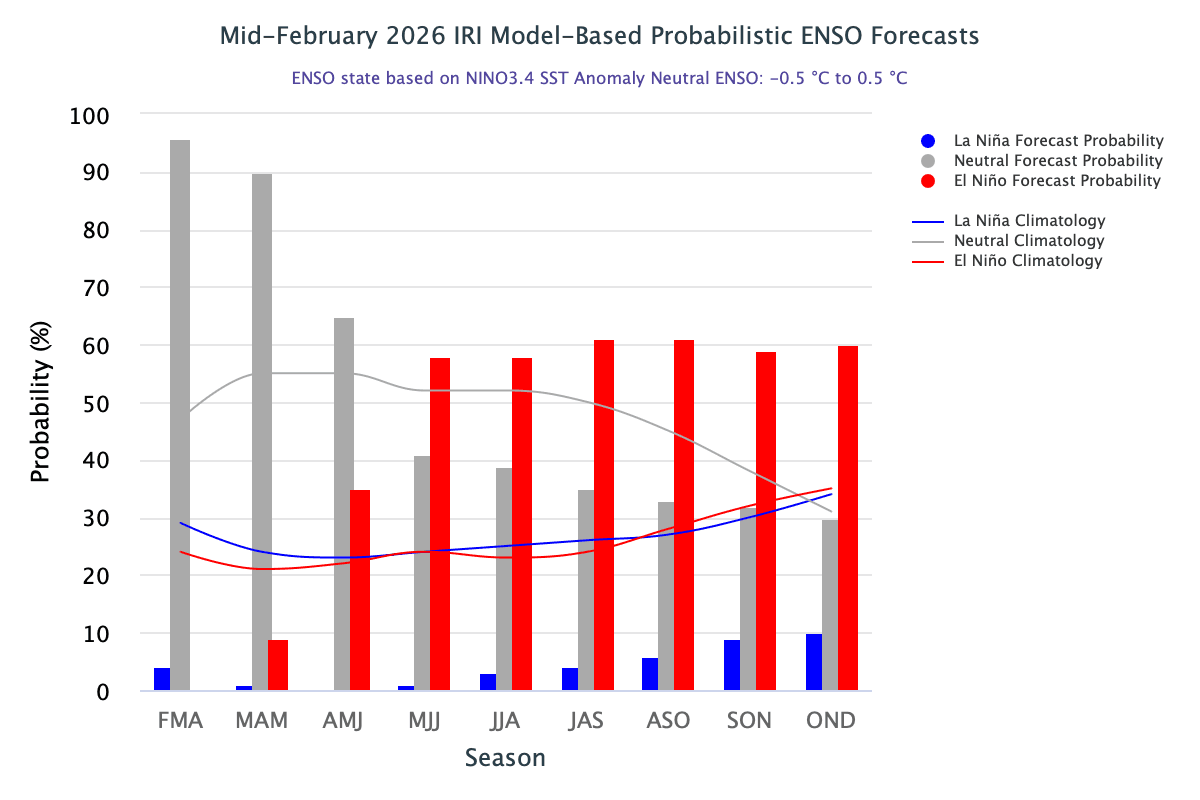
In the last four weeks, equatorial SSTs were below average in the east-central Pacific Ocean and above average in the western and far eastern Pacific. The variation was large in the Nino 3.4 region, but still remains consistent with La Nina conditions. The SSTs have dropped across the Nino regions during the last week. Nino 3.4 is likely to remain below the threshold mark of -0.5°C. Transition from La Nina to ENSO-neutral is expected in Feb-Apr 2026 (60% chance), with ENSO-neutral likely persisting through the Northern Hemisphere summer (56% chance) in Jun-Aug 2026.
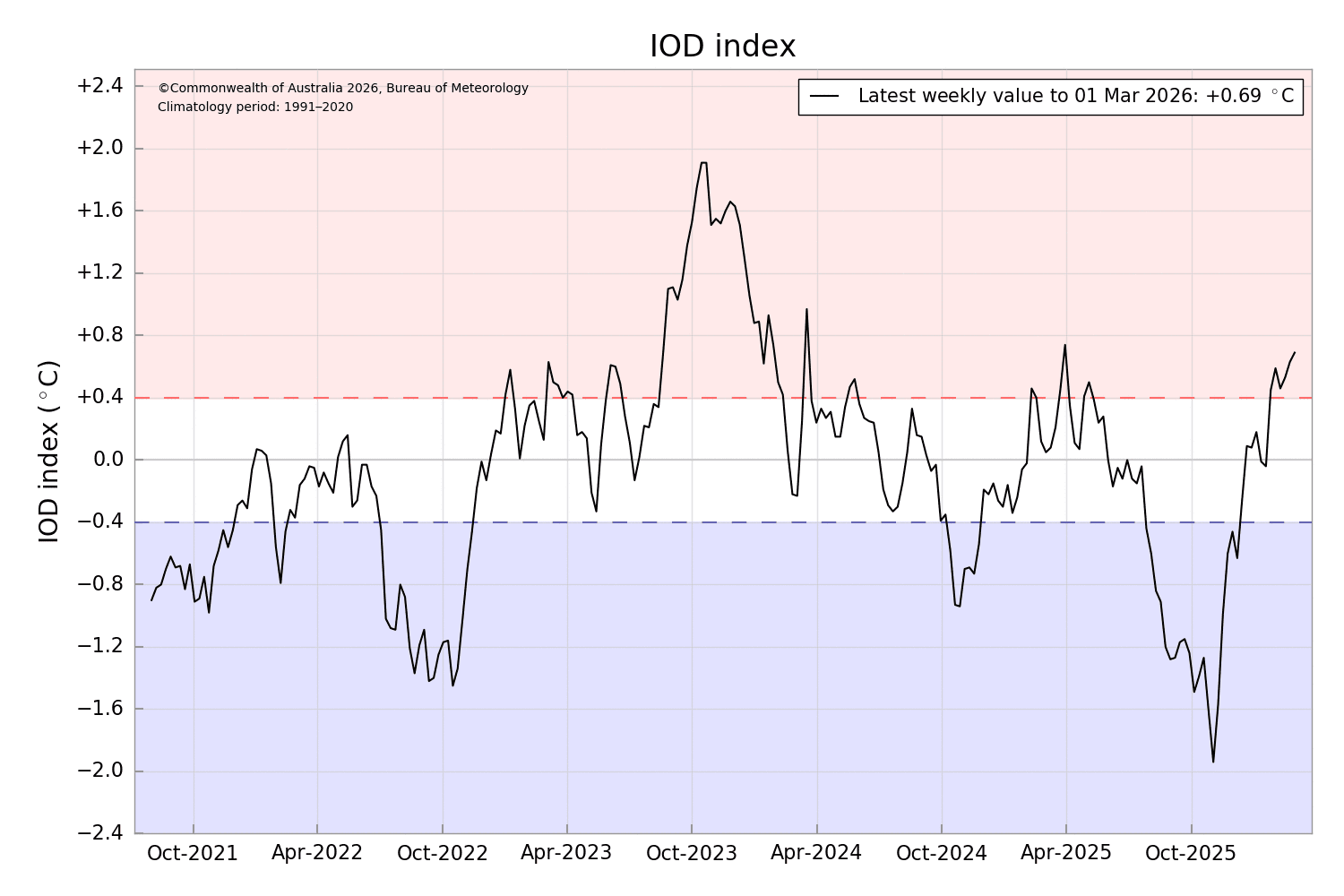
IOD: The Indian Ocean Dipole index has remained above the positive threshold of +0.4°C for the last six weeks. Anything up to eight weeks or more will lead to a positive IOD event, a little early in the season. As per historical data, climatological probabilities suggest IOD-neutral between Feb-Jun 2026, and a shift towards positive IOD takes place during Jun-Aug. The occurrence of consecutive positive IOD events is extremely rare. The best combination of alternating positive and negative IOD is the more familiar pattern. Last monsoon, the IOD was negative and so climatologically, Monsoon 2026 will more likely have a positive or a neutral IOD. The chances of negative IOD developing are the least.
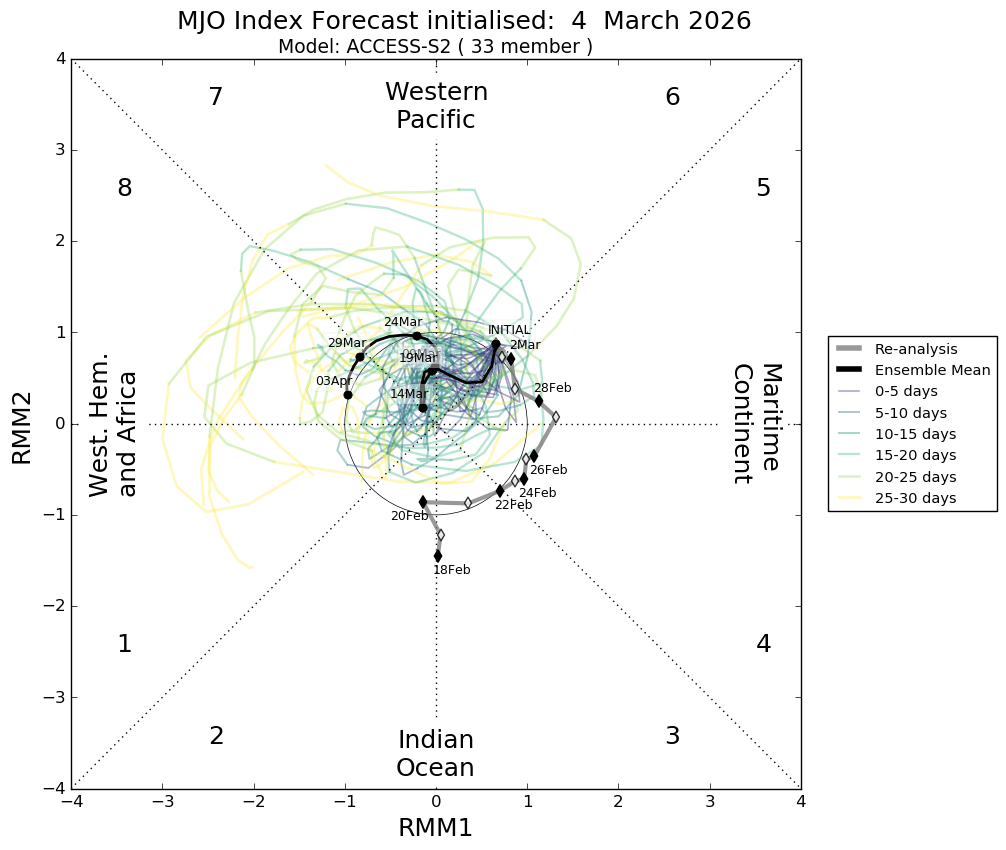
MJO: The MJO signal is likely to remain suppressed till mid-March 2026. The amplitude will be confined to the inner circle. The MJO pulse will effectively manage to grow after the third week of March. Between the first and third week, it will keep meandering over the Western Pacific in Phase 6 & 7. It is unlikely to react adversely with La Nina in the Pacific during this period.
In the absence of an active MJO pulse, the entire Northern Hemisphere is free from any stormy activity. The Indian seas are also likely to remain dormant. The changed El Nino criterion is likely to increase the La Nina events, both in intensity and duration. Conversely, the El Nino events are likely to shrink, both in expanse and strength. ENSO-neutral may emerge as the most dominant category.