Consecutive Second Week Of Poor Rainfall: Season Ends As Least Rainiest


Image: AI-Skymet
Key Takeaways:
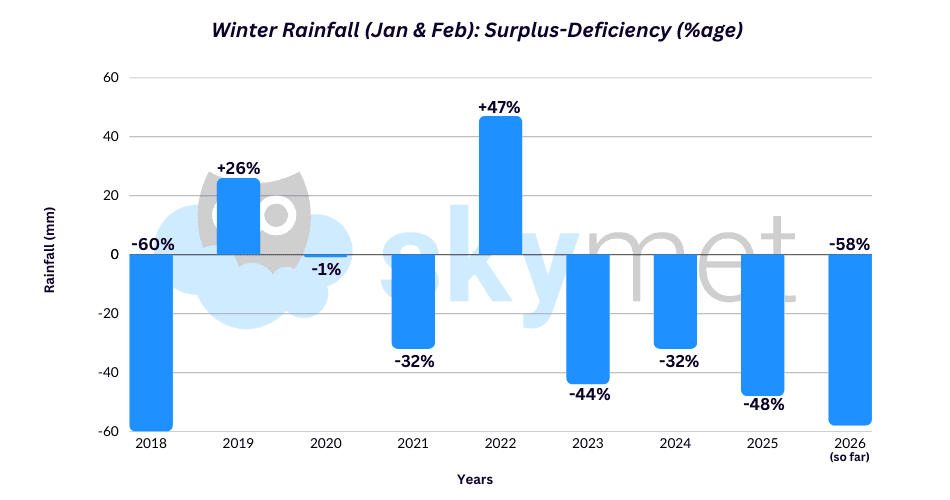
- February ended with nearly 60% seasonal rainfall deficit, highest in a decade.
- East and Northeast India recorded extreme shortfalls, up to 99%.
- Tamil Nadu was the only state with large excess rainfall.
- Pre-Monsoon 2026 likely to begin mildly before intensifying in April and May.
Week after week, the rain deficit kept growing in the month of February, leading to a seasonal deficit of nearly 60% rainfall. This is the highest winter season shortfall for the country, at least for the last one decade. The month of February, the rainiest winter month for North India, performed poorer than January. Individually, all the four homogeneous regions of the country witnessed rainfall deficiency, more glaringly over East and Northeast India.
The week between 12th and 18th Feb 2026 was practically rainless, as it had a shortfall of 98% rainfall. The following week, between 19th and 25th Feb 2026, was deficient by 70%, a shade better than the previous one. This was largely due to a weather system over the Bay of Bengal, which gave decent showers over South India. Northeast India was the worst of all, with a deficiency of 99% rainfall over Assam & Meghalaya and Nagaland, Manipur, Mizoram and Tripura. Bihar and Jharkhand also met with a similar fate. West Bengal had conciliatory rainfall in some pockets but still observed a shortfall of 84%.
The Indian region has not witnessed a decent winter season for the last four consecutive years. The satisfactory season was last observed in 2019 and 2022. Season 2026 witnessed decent rains only in two sub-divisions, namely Tamil Nadu and Kerala. Tamil Nadu gathered a large excess of 69% rainfall and Kerala observed a marginal shortfall of 13%. Over the northern parts, the state of Punjab was an exclusive pocket with a nominal shortfall of 6% rainfall. Pre-Monsoon 2026 will also start on a milder note during the first half of March. It is likely to catch up later, in the months of April and May.