Monsoon 2026 Detailed Forecast: Below Normal Rainfall Likely; Uneven Distribution Expected


Image: Skymet
Key Takeaways:
- Monsoon 2026 likely at 94% of LPA, indicating a below-normal season
- 70% probability of below-normal to drought conditions across India
- Central India & Western Ghats to offer limited rainfall support
- North, West & Central regions may face significant rainfall deficits
India’s Southwest Monsoon 2026 is expected to remain below normal, with seasonal rainfall projected at around 94% of the Long Period Average (LPA).
While selected pockets such as the Western Ghats and parts of central India may receive relatively better rainfall, the overall monsoon is likely to be deficient and uneven across regions.
What Do the Probabilities Say? (JJAS Outlook Explained Simply)
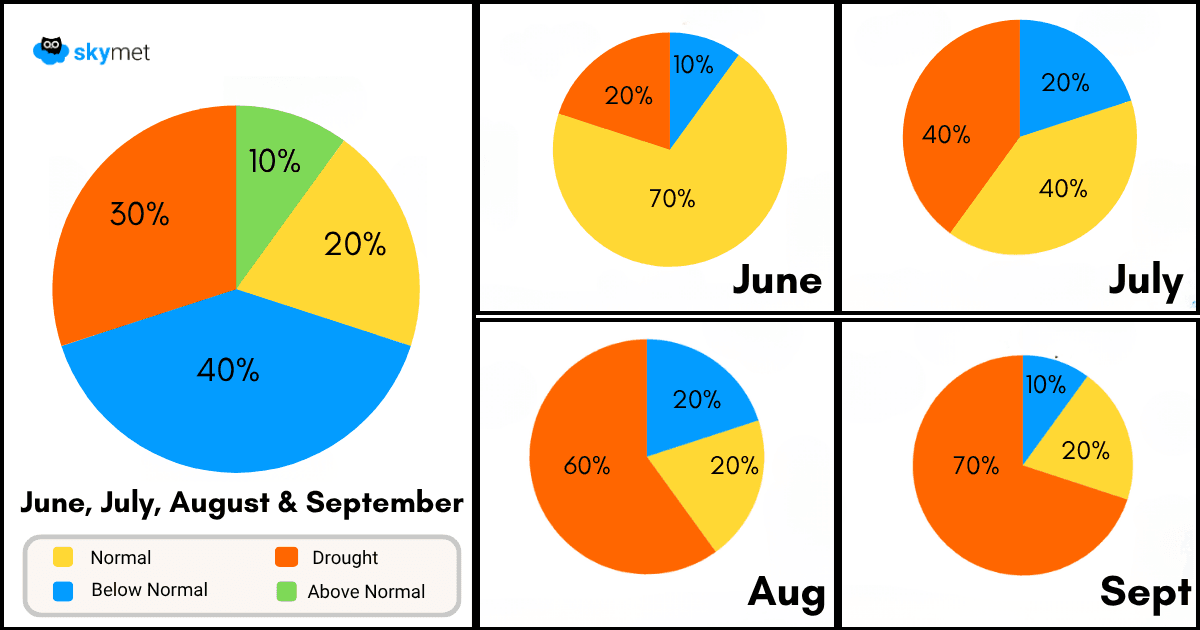
The seasonal outlook for the June to September period (JJAS) shows a clear tilt toward weaker monsoon conditions. The probability distribution indicates:
- 40% chance of Below Normal rainfall
- 30% chance of Drought conditions
- 20% chance of Normal rainfall
- 10% chance of Above Normal rainfall
This translates to a 70% likelihood of below-normal to drought conditions, highlighting a strong negative bias for the season.
The chances of a healthy or surplus monsoon remain limited, suggesting that rainfall may lack consistency and fail to sustain across large parts of the country.
At the monthly scale, June may begin near normal, supported by neutral to slightly positive oceanic conditions. However, July onward may see increasing variability, with August and September turning more erratic and deficit-prone, in line with the strengthening El Niño signal.
Overall, the monsoon is expected to show an uneven progression, with short active spells but prolonged weak phases, particularly during the second half of the season.
Where Will It Rain More or Less? (State-wise & Regional Outlook)
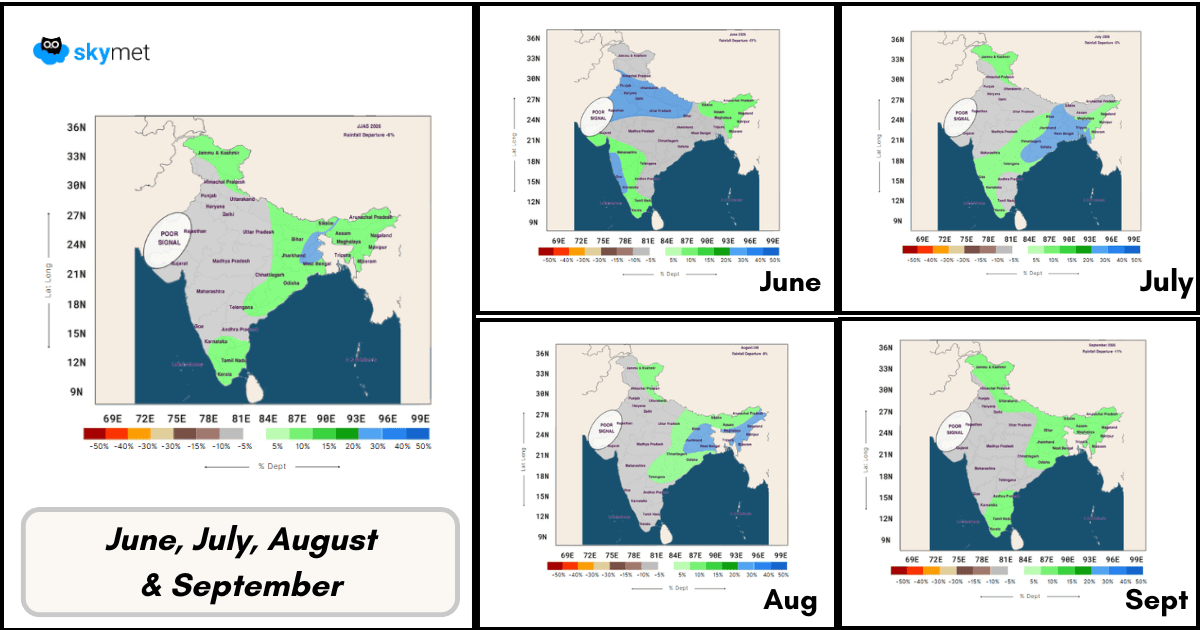
The spatial distribution indicates an overall seasonal rainfall departure of around -6%, reinforcing a slightly below-normal monsoon at the national scale.
However, the distribution will be highly uneven:
- Better rainfall pockets:
Parts of the Western Ghats (Konkan, Goa, Coastal Karnataka, Kerala) and limited areas of central India may witness near-normal rainfall during active phases, offering some support to the seasonal performance.
- Normal rainfall regions:
The southern peninsula is likely to experience largely normal rainfall, ensuring relatively stable conditions compared to the rest of the country.
- Deficit regions (key concern):
North, West, and Central India, including Rajasthan, Gujarat, Punjab, Haryana, and parts of Madhya Pradesh, are expected to receive below-normal rainfall, contributing significantly to the seasonal shortfall.
- Eastern & Northeast India:
Contrary to the rest of the country, parts of the East and Northeast may remain better placed, with episodes of above-normal rainfall, though not uniformly distributed.
- Northern hills:
Regions such as Jammu & Kashmir and Ladakh are likely to observe subdued rainfall activity through the season.
At the monthly level, June may favour southern and coastal regions, while July–August will shift activity toward central India, albeit inconsistently. By September, rainfall is expected to decline sharply across most parts, marking an early weakening phase.
What Does This Mean for India?
The expected rainfall pattern suggests that agricultural activity across major crop-growing regions is likely to remain largely favourable, particularly in central and western India.
Reservoir levels and groundwater recharge are expected to improve steadily through the season, supported by consistent rainfall during the peak months.
However, localized risks cannot be ruled out, as flood-like situations may develop in regions receiving above-normal rainfall, especially across central India and the Western Ghats, while deficit conditions may emerge in parts of Northeast India and northern hill states.
Final Takeaway
The Southwest Monsoon 2026 (JJAS) is expected to be below normal with a clear negative bias, characterised by erratic rainfall, stronger second-half weakness, and uneven spatial distribution, with only limited regions offering support to the overall seasonal outcome.
Skymet Exclusive: Skymet Weather Forecasts Below Normal Monsoon For India in 2026