Bengaluru Struggles For Monsoon Rains: July May Go Driest On Record


Key Takeaways:
- Bengaluru has recorded virtually no rainfall in July, with only 0.2 mm at the City Observatory and a trace at HAL.
- South Interior Karnataka has a 28% rainfall deficit, while Coastal Karnataka is 36% below normal.
- Weather conditions remain unfavourable for widespread rainfall over the next 10 days.
- The second half of the monsoon season still offers better rainfall prospects, with August and September normally contributing over 60% of seasonal rainfall.
- Forecast Validity: Upcoming 10 days.
Monsoon rains have remained rather meagre across the South Peninsula. The entire region is facing a rainfall deficit of 27% between 1st June and 16th July 2026. Among the worst-affected areas are all three meteorological subdivisions of Karnataka. The rainiest subdivision, Coastal Karnataka, is facing a rainfall deficit of 36%, while South Interior Karnataka, which includes Bengaluru, has recorded a shortfall of 28% during this period.
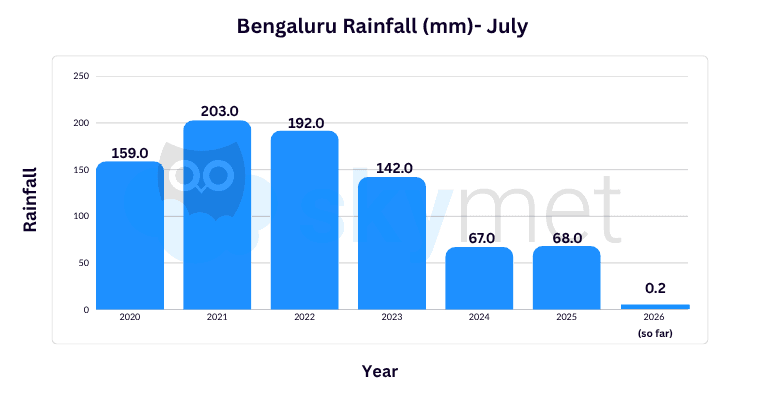
Both the rural and urban parts of Bengaluru have remained virtually dry so far in July. The HAL observatory has recorded only a trace of rainfall, while the City Observatory has received just 0.2 mm during the month. Bengaluru typically does not receive very heavy rainfall during the first half of the monsoon, and the city's normal rainfall for July is a modest 116.4 mm. Even during the last two years, the city received only 67 mm and 68 mm of rainfall in July 2024 and July 2025, respectively. However, the city has been literally starved of rain during the current monsoon season.
Ironically, the upcoming meteorological conditions do not indicate any significant relief. The offshore trough along the Kerala-Karnataka coast remains largely inactive, while the monsoon westerly flow is too weak to trigger any widespread showers. Over the next 10 days, Bengaluru may witness only a few light spells over isolated parts of the city for a day or two towards the end of next week. The rainfall deficit is therefore likely to increase further, adding to the challenges faced by the farming community.
Overall, Bengaluru is heading towards an extremely poor monsoon performance in July 2026. In all likelihood, the month could end up as one of the driest Julys on record. However, climatological normals indicate that the second half of the monsoon season (August and September) is wetter, with the city typically receiving more than 60% of its seasonal rainfall during these two months.